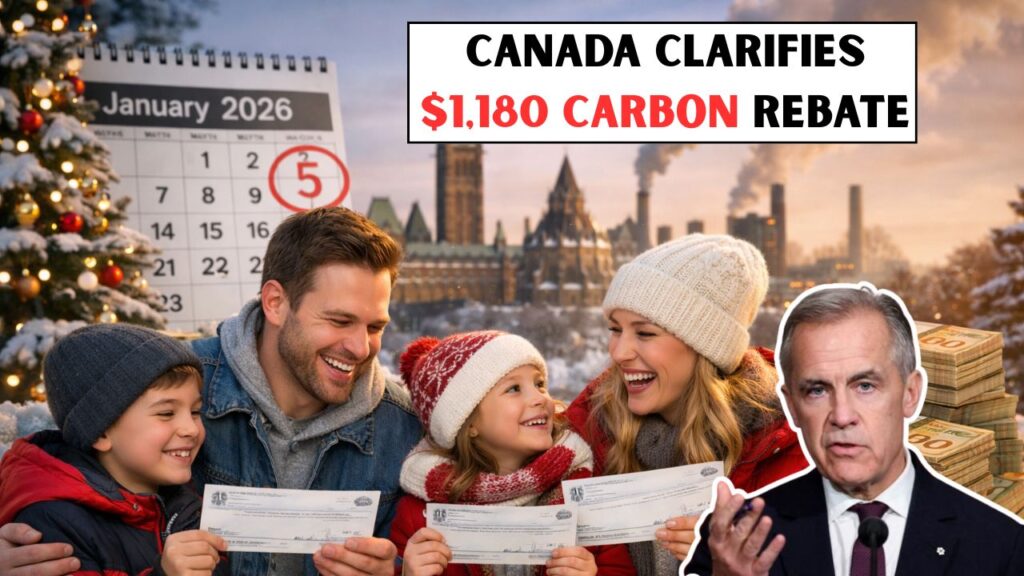
Canadian Payment Rules – Canadians are heading into 2026 with clearer rules around the federal carbon rebate, ending months of confusion for households trying to understand how much support they will receive. From 5 January 2026, updated payment structures apply to the Climate Action Incentive, with eligible individuals and families receiving up to $1,180 annually depending on province and household size. The changes are designed to simplify calculations, improve transparency, and align rebates more closely with rising living costs across the country. For many residents, especially in higher-cost regions, these adjustments provide predictability and help with long-term household budgeting.
Carbon Rebate Payment Rules Update for Canadian Residents
The revised carbon rebate payment rules for Canadian residents aim to remove uncertainty around eligibility and payout amounts. Under the updated approach, rebates are standardized by province and household composition, making it easier for people to estimate what they will receive each year. Payments continue to be issued quarterly through direct deposit or cheque, but the new framework clarifies how annual totals like the $1,180 figure are calculated. For households in provinces under the federal pricing system, this change offers reassurance that rebates are structured to offset carbon pricing costs fairly, especially for middle- and lower-income earners.
$1,180 Climate Action Incentive Explained Across Canada
Across Canada, the $1,180 Climate Action Incentive amount represents the maximum annual rebate for eligible families in certain provinces starting January 2026. This figure is not universal but depends on factors such as province of residence, marital status, and number of children. The updated guidance makes clear that most households will receive rebates that exceed what they pay in carbon pricing directly. By clearly outlining provincial variations, the federal government has reduced misunderstandings that previously led many Canadians to underestimate their entitlements or assume they were ineligible.

| Item | Updated Information |
|---|---|
| Start Date | 5 January 2026 |
| Maximum Annual Rebate | Up to $1,180 per household |
| Payment Frequency | Quarterly |
| Eligible Regions | Provinces under federal carbon pricing |
How the New Carbon Rebate System Affects Canadians in 2026
For Canadians in 2026, the updated carbon rebate system brings predictability and clearer communication. Instead of complex formulas, households can now reference straightforward provincial tables to understand expected payments. This is particularly helpful for seniors, families with children, and individuals on fixed incomes who rely on predictable cash flow. The clarified rules also reduce errors and delays, as eligibility is now more closely linked to tax filing status. Overall, the changes are expected to improve public trust in the rebate system while ensuring environmental pricing policies remain socially balanced.
Eligibility and Payment Access for Households in Canada
Households in Canada remain eligible for the carbon rebate as long as they file an annual tax return and reside in a province subject to the federal carbon pricing system. No separate application is required, which simplifies access for most people. Payments are automatically issued based on tax records, with direct deposit being the fastest option. The clarified eligibility rules also help newcomers and young adults understand when they qualify. By streamlining access, the updated system ensures support reaches households efficiently without additional administrative burden.
Frequently Asked Questions (FAQs)

1. When do the new carbon rebate rules take effect?
The updated rules apply from 5 January 2026.
2. Is $1,180 guaranteed for every household?
No, the amount varies by province and household size.
3. Do I need to apply separately for the rebate?
No, filing your annual tax return is sufficient.
4. How often will payments be made?
Payments will continue to be issued quarterly.